This is the third part of the Compost Happens –BioBag Employee Sharpens The Saw. For those of you that missed part one & two, you can read it on the BioBag blog, BioBabble. I appreciated all the comments and I hope someone learned a thing or two from the previous installments. Let’s now leap into the continuation of Compost Happens.
Part 3 will go over the Two Most Popular Types of Compost Units.
TYPES OF COMPOST UNITS
Compost units can be classified in many ways but the two most popular are “holding units” and “turning units”. Holding units include bins which have been constructed from wire, wood, masonry, plastic, or combo of these materials. Turning units normally include barrels that are turned horizontally or end to end.
When setting up a holding or turning bin, make sure it is in an area protected from drying winds and where it can be reached by a garden hose. It is also a good idea to place the unit/bin in a shady area, away from direct sunlight.
Holding Bin Units
Holding Bins are most popular type of home yard compost unit. They are the simplest and least expensive type of bin however, they are slower to product compost. Depending on the maintenance, these can take 6 months to 2 years to produce finished compost.
No matter if you are using wire, wood or plastic, the bin composting units should be at least 3 feet wide, 3 feet long and 3 feet high. Larger constructed units will work even better because of better heat retention.
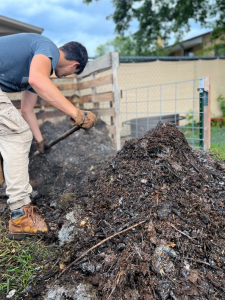
It is very beneficial to construct two or three units/ segments like the one pictured. These type of units facilitate turning and maturing of the composting material. You start at one end of the unit by adding your mixture of browns and greens (30:1). As the first pile decomposes, you move it down to the second section and start all over in the first section. As the second section breaks down even more, you move it to the third section for final curing. Once the third section is finished composting and the compost has been collected, you move the second into the third, the first into the second and start all over again with the first. You’ll always have compost in its different decomposition stages.
Whether you use the sectional holding bin or a single section holding bin, the best way to go about creating a compost pile is the Sandwich Method.
Alternate 3” – 4” layers of green and brown material
Water each layer until moist (not wet) before adding an additional layer on top
Keep layering until the pile is about 3 feet tall, ending with a layer of browns(Smaller particles decompose faster so try to mulch or cut up the larger yard and food scraps)
Turning Units
The turning units should produce compost more quickly than a holding unit, if they are attentively managed. They can produce compost in two months or less. Barrel units tend to have smaller capacities than most other bins, including holding bins, which make them better suited for people with small amounts of yard trimmings and food scraps. Turning units are a great option for deterring pests however, organic waste shouldn’t be continuously added but stockpiled until the first batch as been processed. As you can imagine, stockpiling organics in itself can be problematic.
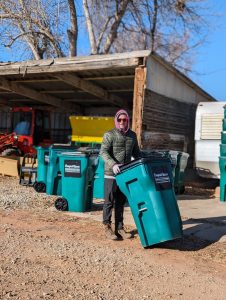
The most commonly used turning units are plastic barrels like the one pictured. Barrel compost units can be turned on either the vertical or horizontal axis depending on the manufacturer set up or how you build one.
Looks like we will be continuing on to Part 4 where we will talk about maintaining your compost pile. Parts 1- 3 and future “parts” will all be archived on our Blog, BioBabble!
If you would like to take a composting class, check out your local county website. My class was put on for FREE by the Florida Cooperative Extensive Service of the University of Florida. There are classes just like this one across the U.S
This Month’s BIG SHOUT-OUT goes to San Francisco, CA!!!
On November 22, the City of San Francisco celebrated its one-millionth ton of collected organic waste. The city has the highest organic collection rate in the nation. This massive program collects the city’s organic waste, diverts it from landfills and turns into nutrient-rich compost. The symbolic one-millionth ton was collected at Scoma’s Restaurant where Chef Bennett said that they have given tours of their dumpsters to people from all over the world and they recycle 95% of their total waste.
San Francisco-based Recology, the hauler that collects the city’s organics, started collecting food scraps and other organic materials from residents and businesses in 1996. It took 15 years to get to the first million but Recology’s Mike Sangiacomo thinks they’ll do the second in 5.
Currently, San Francisco is recycling 78% of its garbage with a 2020 goal to be a completely zero waste city.
Congratulations to the City of San Francisco and all the participating businesses, organizations and residents of this program. One Million Tons is truly an amazing and inspirational accomplishment.
For more information and the full article visit, NBC Bay Area.
Check out the Q & A session between Mindy Goldis, blogger of My r-Awesome Life and our very own Marketing Manager, Jennifer Wagner. How would you have answered question #6?
Pumpkin guts, old jack-o-lanterns, costumes from the ghosts of Halloween Past and of course, the TONS of leftover candy! (well maybe not the most desirable chocolate one but you know those, yucky black and orange wrapper one)
What to do with all of this waste? All holidays can produce an enormous amount of holiday cheer surplus but is Halloween the most? Probably not, but it does it’s fair share of competing. What is someone eco-friendly like yourself to do with all that waste? Well, luckily all the candy rejects, the moldy jack-o-lanterns and pumpkin innards can be composted! Hurray!!!! Check out Green Halloween’s video here to see how easy-breezy it is.
As for the old costumes, donating will probably be the best option as well as participating in a costume swap next year!
Starting today, (Oct 31) Portland residents can now put out their food scraps for collection at the curb along with their yard debris in their green carts. Every household (about 180,000) received a 2-gallon food scrap collection bucket and coupons for compostable bags.
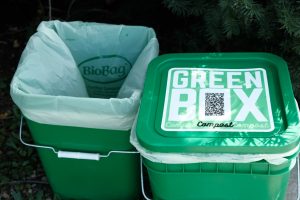
Residents may use newspaper, paper bags and approved compostable bags (i.e. BioBags) to line their pails. If you or someone you know lives in Portland, you can get BioBags at the approved retailers linked here.
For more information about the Portland Composting Program visit, portlandcomposts.com
This is the second part of the Compost Happens –BioBag Employee Sharpens The Saw. For those of you that missed part one, you can read it on the BioBag blog, BioBabble. I appreciated all the comments and hope someone learned a thing or two about Aerobic and Anaerobic composting, the bacteria involved in the process and the larger organisms that inhabit the piles. Even some BioBag employee’s saws were a little sharper from proofing and reading the previous newsletter.
With that all said, let’s jump into the continuation of Compost Happens. We will go over Compost Terminology, Benefits of Composting and What To Compost and What Not to Compost.
Composting Benefits
Improves soil condition and structure
Increases the soil’s ability to hold water
Support leaving organisms
Helps dissolves mineral forms of nutrients
Buffers soil from chemical imbalances
May provide biological control of certain pests
Helps return organic materials to the soil and keep them out of landfills and waterways
(Wow! Compost is BLACK GOLD!)
Compost Terminology
Here are some simple composting terms:
Composting: Controlled decomposition of organic materials
Compost: Partially decomposed organic matter
Humus: Completely decomposed organic matter
Mulch: Organic or inorganic spread on soil surface
Browns or the Carbon component in the composting process: Leaves, sawdust, wood chips
Greens or the Nitrogen component in the composting process: Manure, food waste, spent flowers, nitrogen fertilizers, grass clippings
The Ideal Mixture of Brown to Green when composting is a ratio of 30:1 (30 Brown : 1 Green)
Compost what?
Now, depending on what method of composting you participate in will determine the material input that can be composted. Of course through industrial composting where machinery, technology, manpower and time are readily available, many more things can be composted including dog waste, meat and dairy products. These three items are not normally recommended for home composting.
This is a sample of items that should be A-OK for your home composting.
Fruit and vegetables left overs (stalks, seeds, peels, skins)
Breads, grains, rice, flour, cereal, pasta
Yard trimmings, wood chips, plants, flowers, leaves, straw, hay
Natural fibers (cotton, wool, linen)
Hair (human and animal)
Feathers
Herbivore manure
Coffee grounds and filters as well as tea leaves and bags (no staples)
Newsprint, paper, cardboard, paper plates, cups and napkins
Eggshells
Looks like we will be continuing to at least a Part 3. I haven’t even scratched the surface of HOW to actually compost. Part 1, Part 2 and future “Parts” will all be archived on our Blog, BioBabble!
If you would like to take a composting class, check out your local county website. My class was put on for FREE by the Florida Cooperative Extensive Service of the University of Florida. There are classes just like this one across the U.S
Free Composting and Irrigation stuff I got from the class.
Stephen R Covey published his “Seven Habits of Highly Effective People” in the late 1980′s. The 7th and maybe the most important habit is to “Sharpen the Saw”. Sharpening the Saw means preserving and enhancing the greatest asset you have–you. Luckily for me, I work at a company that supports and promotes its employees taking the time to enhance themselves personally and professionally.
To expand my knowledge as well as reconnect with nature, I took a class last week on Composting. I would consider my knowledge of composting intermediate from working here at BioBag, but I could use a little sharpening. I’d like to share with you some tips, that I either newly learned or that were refreshers, from the class. We went over a lot of information that day so I think it best to break it up into parts. This is Part 1.
Composting:
Anaerobic (without oxygen): decomposition that is often called fermentation or putrefaction. It is usually accompanied by the release of methane or the foul odor of hydrogen sulfide (rotten egg smell). Anaerobic decomposition occurs slowly and little heat is generated.
Aerobic (with oxygen): a naturally occurring process in nature where organic waste is converted into humus. There is little to no smell. The process creates lots of energy in the form of heat. The heat is an advantage as it destroys pathogens and parasites.
The cast of characters that aid in composting are: bacteria, fungi, millipedes, earthworms and other living inhabitants.
There are 3 types of bacteria:
Psychrophilic (low temperature bacteria)
Mesophilic (40 – 110 degrees F) they do most of the work in the compost piles
Thermophilic (104 – 200 degrees F)
All bacteria need nitrogen and carbon to survive and thrive. Nitrogen provides the microbes with the raw element to multiply. Carbon is the energy source. Bacteria get a complete meal when the carbon to nitrogen ration is 30:1.
Moisture content of 40% – 60% is ideal for bacteria. If it is less than 40%, the bacteria slow down and go dormant. If the moisture content is 60%+, it is too wet which means the pile looses too much air and anaerobic conditions set in.
Turning the pile brings fresh air to the microbes in which their numbers multiply quickly. More microbes = Faster decomposition = Quicker compost
As the pile cools or in the later stages of decomposition, other larger organisms settle in.
Fungi are major decomposers in the compost pile however, not as efficient as bacteria.
Nematodes or roundworms
Fermentation mites
Springtails
Wolf Spiders
Centipedes
Sow bugs
Ground beetles
Earthworms
A slight detour. One cool factoid about Grass Clippings:
Grass clippings can be directly recycled by letting them fall back in the lawn as you mow. Clippings are 90% water and break down quickly, releasing nutrients equivalent to one or two fertilizations a year.
Like I said, this only covered a portion of what was presented in the class. Be on the look out for Part 2 next month with a possible Part 3.
If you would like to take a composting class, check out your local county website. My class was put on for FREE by the Florida Cooperative Extensive Service of the University of Florida. There are classes just like this one across the U.S. Take some time for you, our earth and Sharpen that Composting Saw! (Plus you might get a lot of cool composting schwag like I did. I plan to start my own composting pile soon. See photo below)
Free Composting and Irrigation stuff I got from the class